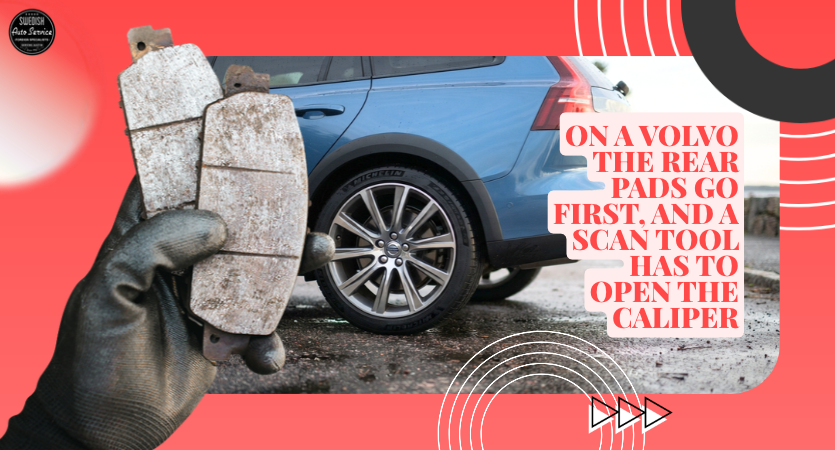
On most cars the front pads are the ones that run out first. On a late-model Volvo the order often reverses, and owners of an XC60 or XC90 around Austin find themselves buying rear pads with plenty of front material left. Nothing is broken. It is how the car is designed to brake, combined with an electronic parking brake that has to be wound back electronically before anyone can get the old pads out.
Quick Summary: Key Takeaways
- Volvo works the rear brakes harder than older cars did: stability and brake control systems put real duty through that axle.
- The rear caliper has a motor on it: a scan tool has to wind the piston back before the pads will come out.
- Forcing the piston back damages the actuator: a pad job becomes a caliper job.
- The system needs recalibrating afterward: skip the step and the parking brake holds poorly.
Why the rear brakes do more work than they used to
Electronic brake force distribution replaced the mechanical proportioning valve years ago, and it lets the car send far more braking to the rear axle than a fixed valve ever safely could, adjusting it continuously based on load and deceleration. Stability control adds to that, applying individual rear brakes in corners to keep the car pointed where the steering says.
On a Volvo with the full suite of driver assistance, the car also brakes itself on occasion, and those interventions are not gentle. Every one of them is pad wear the driver did not knowingly ask for.
The result is a rear pad that sees far more duty than the geometry alone suggests. It also happens that rear pads are thinner to begin with on many of these cars, so the same amount of wear uses up a larger share of them.
The part that catches people out
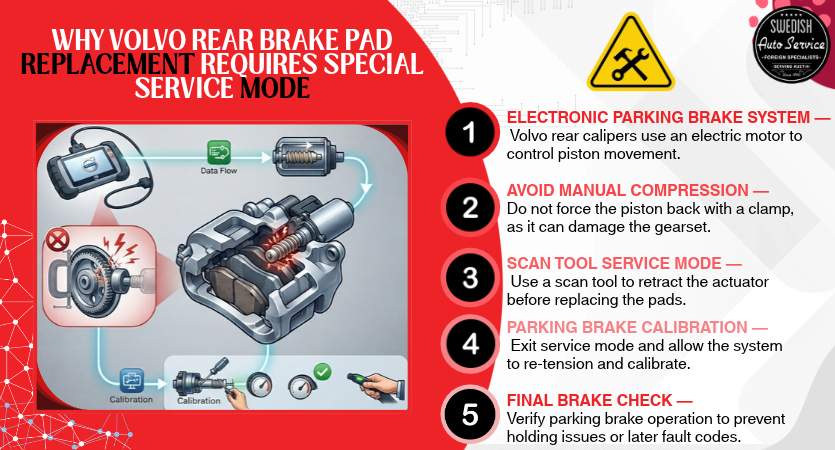
Open the caliper on an older car and you wind or press the piston back into its bore. On a Volvo with an electronic parking brake, the rear caliper piston is driven by a small electric motor and a screw mechanism. The motor holds the piston where it is. Press on it with a clamp and you are pushing against a gearset that was never meant to take the load.
The correct procedure is to put the system into service mode with a scan tool, which drives the actuator fully back, then do the pad work, then bring it out of service mode and let the car re-tension and calibrate the parking brake. Miss the last step and the parking brake either will not hold on a slope or sets a fault some miles later.
This is the reason a Volvo rear pad job costs more than the pads suggest, and the reason a shop without the software should not be attempting it.
What else gets inspected while the wheels are off
The caliper slide pins and the pad abutment hardware matter more on the rear than the front, because the parking brake mechanism means the caliper has to retract cleanly every time. A sticking pin on a rear caliper shows up as a pad that wears on one side only, and as a parking brake that drags.
Rotor thickness gets measured, not estimated. Austin’s stop-and-go traffic puts a lot of heat cycles into a rotor, and heat cycling is what produces thickness variation, the real cause of most brake pulsation. A rotor below the manufacturer’s minimum does not get reused regardless of how it looks.
The brake fluid gets tested for moisture content at the same time, since it is the one fluid in the car that absorbs water from the air and nobody checks it unless someone is already standing at the caliper. Owners drive in for this from Round Rock and Cedar Park as well as Austin.
The dust is not nothing, incidentally. Testing six light-duty vehicles on a dynamometer, California’s Air Resources Board put brake wear particulate at 3.3 to 13.6 mg per mile at the vehicle level. None of it shows until it has built up on the wheel, so a proper inspection means taking the wheels off instead of looking through the spokes.
Frequently Asked Questions
Q: How many miles should Volvo rear brake pads last?
A: There is no single figure, and anyone who quotes one is guessing. Stop-and-go city driving takes them down far faster than a highway commute does. Have them measured rather than scheduled.
Q: Can I change Volvo rear pads myself?
A: Only with a scan tool that can put the electronic parking brake into service mode. Some aftermarket tools do it, many basic code readers do not, and the cost of getting it wrong is a caliper.
Q: Why does the parking brake feel weak after a brake job?
A: Because it was not recalibrated. The actuator needs to re-learn where the pads now sit. The recalibration is a software step done with a scan tool, and nothing under the car gets adjusted by hand.
The Rear Wheels Have to Come Off First
If nobody has had the rear wheels off your Volvo since you bought it, that is the place to start.
Swedish Auto Service, 11008 N Lamar Blvd, Austin, TX 78753. More at swedishautoservice.com.