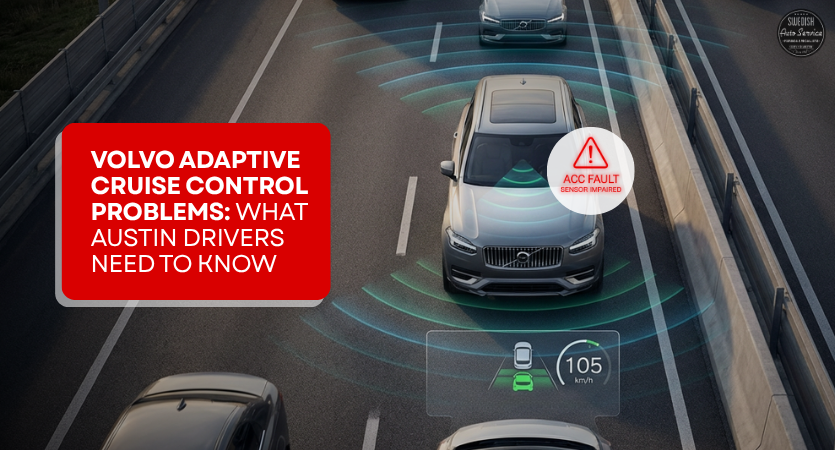
Volvo has long positioned itself at the forefront of automotive safety technology, and adaptive cruise control — known in Volvo’s system as Pilot Assist or Adaptive Cruise Control with Queue Assist — is one of the brand’s flagship driver assistance features. Rather than simply maintaining a set speed, Volvo’s adaptive cruise system uses radar and camera sensors to monitor traffic ahead, automatically adjusting speed to maintain a safe following distance and, in more advanced implementations, providing steering guidance to help keep the car in its lane. When this system works properly, it’s one of the best semi-autonomous driving experiences available. When it malfunctions, it’s not just a convenience issue — it can be a safety concern. At Swedish Auto Service in Austin, we diagnose and repair Volvo driver assistance systems regularly, and here’s what owners should understand.
How Volvo’s Adaptive Cruise Control System Works
Volvo’s adaptive cruise control relies on a sensor array that typically includes a long-range radar unit mounted behind the grille, a camera system integrated into the windshield near the rearview mirror, and processing hardware that fuses the two data streams to create a real-time picture of the vehicle’s environment. The radar handles distance and relative velocity calculations for vehicles ahead, while the camera assists with lane detection and classification of what’s in the driving path. This data feeds into Volvo’s driver support computing module, which communicates with the engine management, brakes, and steering systems to execute speed and following-distance adjustments. Because the system integrates multiple electronic control units, a fault anywhere in this chain — sensor, communication bus, software, or physical alignment — can cause the adaptive cruise function to become unavailable or to behave erratically.
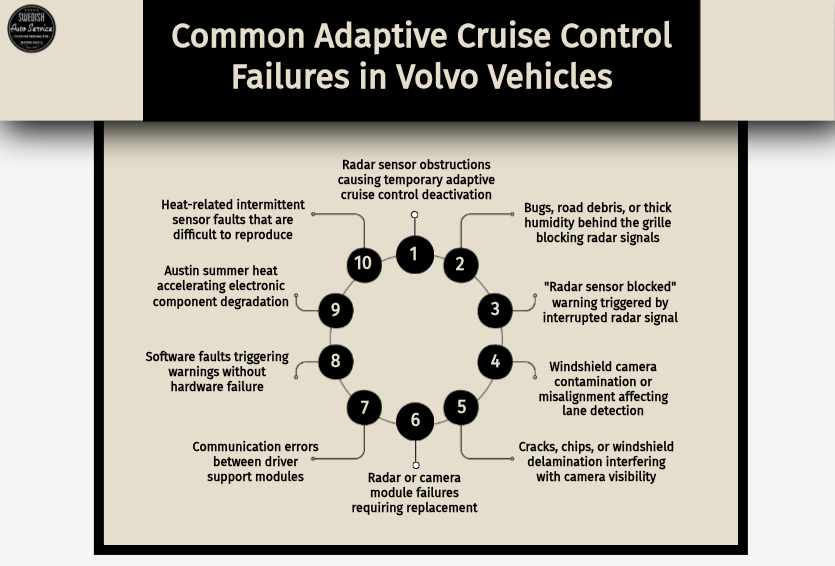
Common Adaptive Cruise Control Failures in Volvo Vehicles
Several failure modes produce adaptive cruise control warnings or malfunctions in Volvo XC60, XC90, S60, V60, and V90 models. Radar sensor obstructions are the most common cause of temporary system deactivation — the sensor is extremely sensitive, and accumulated bugs, road debris, or even thick Texas humidity trapped behind the grille badge can interrupt the radar signal and trigger a “Radar sensor blocked” warning. Windshield camera issues are related to camera position or contamination — including cracks, chips, or delamination of the windshield in the camera’s field of view — which can confuse the lane detection system. More serious faults include radar or camera module failures requiring replacement, communication errors between driver support modules, and software faults that trigger warnings without any hardware failure. Austin’s summer heat accelerates electronic component degradation and can cause intermittent sensor faults that are challenging to reproduce.
Why Proper Diagnosis Matters Before Replacing Components
Adaptive cruise control malfunctions in Volvo vehicles can be expensive to misdiagnose. A radar sensor replacement, for example, requires professional calibration to ensure it’s aimed at the correct angle for the system to measure distances accurately — an uncalibrated radar is worse than no radar, because it will produce incorrect distance readings that compromise the system’s safety function. Similarly, a windshield camera replacement requires calibration using a target board and specialized Volvo diagnostic software to set the camera’s mounting angle reference. At Swedish Auto Service, we scan all relevant Volvo modules for fault codes, inspect the physical sensor mounting and condition, and perform calibration after any component replacement. We don’t replace parts on speculation — we diagnose first to identify the actual failure before recommending a repair.
Calibration After Windshield Replacement
Austin drivers should be aware that replacing a cracked windshield on a Volvo equipped with adaptive cruise control requires recalibration of the forward camera after installation. This is true even if the camera unit itself is undamaged — the act of removing and reinstalling the windshield changes the camera’s reference angle. A windshield replacement shop that doesn’t offer or inform you about camera calibration is leaving your Pilot Assist system in an uncalibrated state, which may produce incorrect lane departure warnings, miscalculated following distances, or system unavailability warnings until calibration is performed.
Schedule Your Volvo Driver Assist Diagnosis in Austin
If your Volvo’s adaptive cruise control is showing warnings or behaving unexpectedly, don’t ignore it. At Swedish Auto Service in Austin, our Volvo-specialized technicians have the diagnostic tools and calibration equipment to identify and resolve the issue accurately. Call us at (512) 836-0022 or visit us at 11008 N Lamar Blvd, Austin, TX 78753 to schedule your appointment.
Frequently Asked Questions
Q: Why does my Volvo say “Radar sensor blocked” on a clear day?
A: The radar is mounted behind the grille badge and is sensitive to buildup. Even a thin layer of road grime or humidity can trigger the warning. Cleaning the grille badge area often resolves it if the sensor itself is undamaged.
Q: Does my Volvo’s adaptive cruise control need calibration after a windshield replacement?
A: Yes — the forward camera requires calibration after any windshield replacement, even if the camera unit wasn’t replaced. This is a critical safety step that should never be skipped.
Q: Can software updates fix Volvo Pilot Assist issues?
A: In some cases, yes. Volvo has released software updates that address adaptive cruise control behavior issues. Our diagnostic process checks current software versions against available updates.
Q: Is it safe to drive my Volvo if the adaptive cruise control warning is on?
A: The base driving functions remain safe, but the driver assistance features will be unavailable. We recommend scheduling a diagnostic soon rather than driving indefinitely with a disabled safety system.