
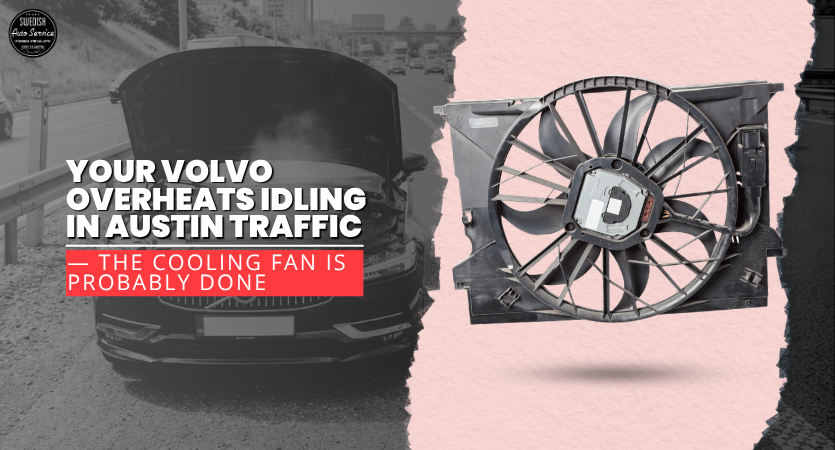
Stuck on MoPac at 5 p.m. in an Austin August, your Volvo‘s temperature gauge starts creeping up while you sit still. Get rolling, and it drops back to normal. That exact pattern points straight at the electric cooling fan. When it quits, summer traffic is where you find out.
Volvo’s XC60, XC90, S60, and V60 rely on a single electric cooling fan and its control module to pull air through the radiator at low speed. In 100-degree Austin heat, a weak fan or a failed module means the engine can’t shed heat in stop-and-go, and coolant temps climb fast. Watched your Volvo run hot while idling this summer? Get the fan tested now.
Quick Summary: Key Takeaways
- The pattern gives it away: Overheating at idle that clears once you’re moving almost always means the cooling fan isn’t pulling air.
- One fan does the work: Modern Volvos use a single electric fan and module, so when it fails, low-speed cooling stops.
- Austin heat speeds failure: Triple-digit summers push the fan motor and module hard and shorten their life.
- Don’t drive it hot: A cheap fan repair becomes a warped head if you keep pushing an overheating engine.
- We test, not guess: A quick scan and bench check tell us whether it’s the fan, the module, or a relay.
Why the Cooling Fan Matters Most in Stop-and-Go
At highway speed, air rams through the radiator on its own. In traffic, the electric fan is the only thing moving air at all. That’s why a dead fan hides all winter and shows up the first hot day you’re stuck on I-35, because sitting still in 100-degree heat with no fan gives coolant temperature nowhere to go but up.
It’s a low-speed problem. Get moving, and the gauge falls. Park in traffic and it climbs. That back-and-forth is the tell.
How Austin Heat Speeds Up Fan and Module Failure
The fan and its control module are electronics living in one of the hottest spots on the car, and Austin summers cook them. The module switches heavy current to spin the fan, and on constant triple-digit days it runs flat out for hours, building heat that eventually cracks solder joints or fries the motor while bearings dry out and brushes wear down. Then the module quits switching.
Heat is cumulative. Every 105-degree afternoon adds up. That’s why these parts so often fail in July and August rather than a mild spring.
The Warning Signs Before the Fan Quits Completely
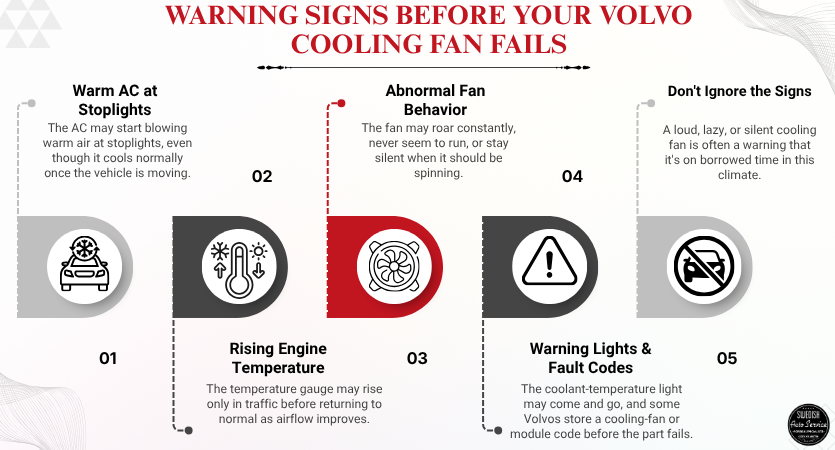
A failing fan usually warns you before it dies. You might notice the AC blowing warm at stoplights, the temperature gauge rising only in traffic, a fan that roars constantly or never seems to run, or a coolant-temperature light that comes and goes. Some Volvos throw a cooling-fan or module code well before the part fails for good.
Trust the small signs. A fan that’s loud, lazy, or dead silent when it should be spinning is on borrowed time in this climate.
Why an Overheating Volvo Can’t Wait
Heat damage happens fast. And it’s the expensive kind. Let coolant temperatures spike and you risk a warped cylinder head, a blown head gasket, and cracked components, turning a modest fan job into a repair in the thousands. A cooling fan assembly is a fraction of that cost.
The stakes are real in summer. AAA expected to rescue 7.7 million drivers this summer, and a stalled-out cooling system in stop-and-go traffic is a classic way to join that list. If the gauge climbs into the red, shut it down. Let it cool rather than limping on.
How We Test and Replace the Fan and Module
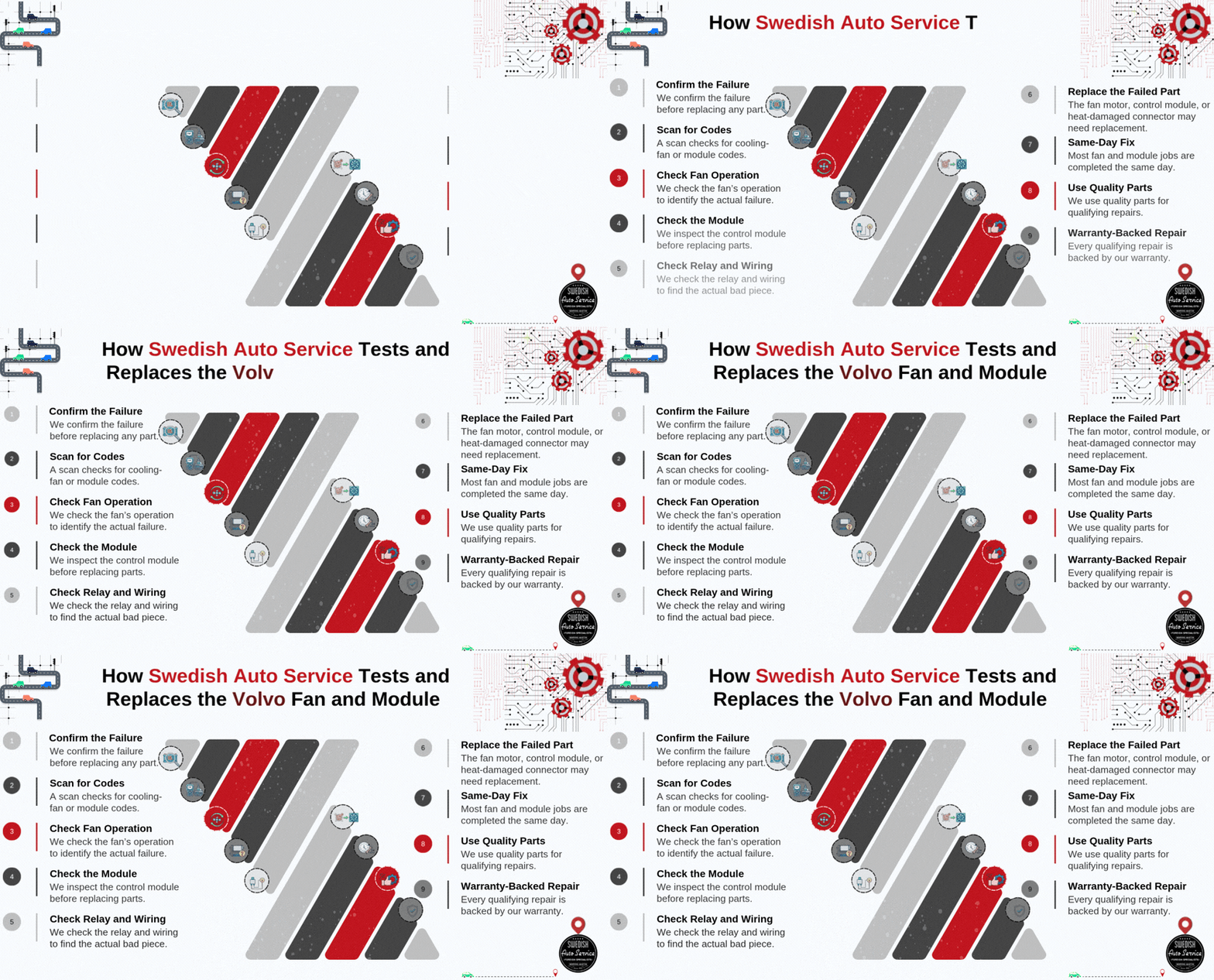
We confirm the failure before we sell you a part. A scan pulls any cooling-fan or module codes, and we check the fan’s operation, the module, the relay, and the wiring so the actual bad piece is what gets replaced. Sometimes it’s the fan motor. Sometimes the control module. Sometimes just a connector cooked by heat.
Most fan and module jobs are a same-day fix. We’ve specialized in Volvo since 1993, we use quality parts, and every qualifying repair is backed by our warranty.
Frequently Asked Questions
Q: Why does my Volvo overheat at idle but not on the highway?
A: Because at highway speed air flows through the radiator naturally, while at idle the electric cooling fan is the only thing moving air. If the fan or its control module has failed, the engine can’t shed heat when you’re stopped, so the gauge climbs in traffic and falls once you’re moving again.
Q: How much does a Volvo cooling fan replacement cost?
A: It varies by model and whether the fan motor, the control module, or both need replacing, but it’s a fraction of what overheating damage costs. The important thing is catching it before high temps warp the head or blow a gasket, which pushes the repair into the thousands.
Q: Is it safe to drive a Volvo with a bad cooling fan in summer?
A: Not in Austin traffic. You might be fine at highway speed, but the first time you’re stuck in stop-and-go, the engine can overheat quickly. If the temperature gauge rises into the red, pull over and let it cool rather than risk serious engine damage.
Q: What are the signs of a Volvo cooling fan module failure?
A: Common signs include the AC blowing warm at idle, the temperature gauge rising only in traffic, a fan that runs constantly or not at all, and stored cooling-fan codes. A proper scan and functional test confirm whether it’s the module, the motor, or the wiring.
Beat the Austin Heat — Get Your Volvo’s Fan Checked
Seeing your Volvo run hot at stoplights? Have the cooling fan and module tested before an August traffic jam cooks the engine.
Hours: Monday–Friday, 8:00 AM – 5:00 PM; Saturday 8:00 AM – 1:00 PM
Website: swedishautoservice.com