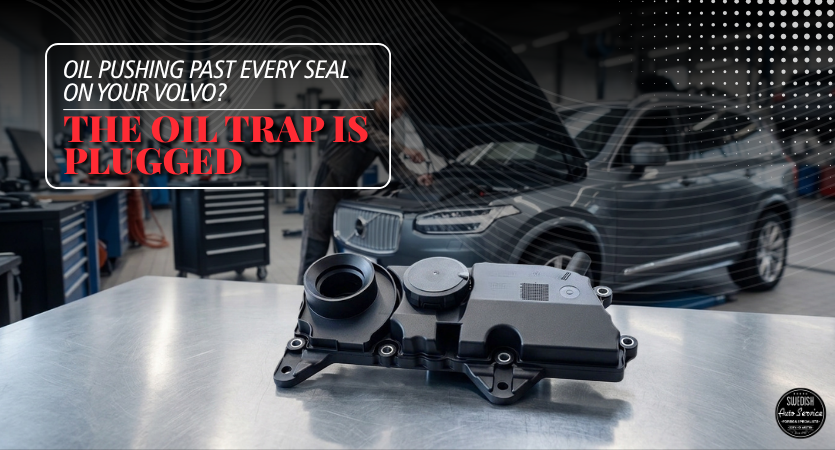
You topped up the oil last month. Now there is a fresh spot on the driveway, the dipstick was sitting half out when you opened the hood, and the front of the engine is damp from the crank seal down. Nobody sells a part called a leak, so three shops have quoted you three different seals.
On a Volvo five-cylinder the real answer is usually further upstream. The oil trap — Volvo’s name for the crankcase ventilation box — is clogged, and the pressure it should be venting is finding its way out through whatever seal is weakest. Swedish Auto Service on North Lamar has been the Volvo shop in Austin long enough to have seen this on S60s, V70s and XC90s from Round Rock to Leander, and cool autumn mornings make a marginal system worse.
Quick Summary: Key Takeaways
- The oil trap is a ventilation system, not a filter: it separates oil mist from crankcase gases and routes the gases back into the intake to be burned.
- Plugged trap means pressurized crankcase: that pressure pushes oil out at the dipstick tube, the cam seals, the front crank seal and eventually the rear main.
- Chasing the seal is the expensive mistake: replace a rear main without fixing the ventilation and the new seal leaks too.
- Short trips are what clog it: a Volvo driven four miles at a time never gets hot enough to boil moisture out of the crankcase.
- There is a two-minute test: a rubber glove over the open dipstick tube tells you more than any parts catalog.
What the oil trap actually does on a Volvo five-cylinder
Every running engine leaks combustion gas past its piston rings into the crankcase. That blow-by has to go somewhere, and on a Volvo it goes through the oil trap: a plastic box under the intake manifold that condenses oil mist out of the vapour and drains it back to the pan while the gas goes forward to be burned again.
It works well for years. Then the passages inside it fill with a mayonnaise-textured mix of oil, fuel and water, the drain hose to the block glazes over, and the box stops breathing.
A clogged trap pushes oil out of every seal in the engine
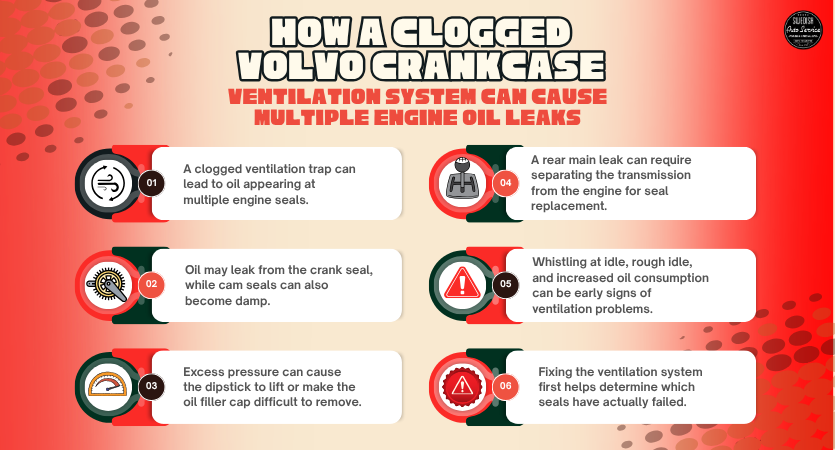
The symptoms look like six separate problems. Oil at the front of the engine from the crank seal. Damp cam seals. A dipstick that will not stay seated, or an oil filler cap that fights you when you twist it off.
Rear main leaks are the costly end of it, because that repair means separating the transmission from the engine on a car that did not need a new seal in the first place — it needed a plastic box and a couple of hoses.
Some owners notice the softer signs first: a whistle at idle, a rough idle that clears when you crack the oil cap, or more oil consumption than the car has ever used. Fix the ventilation first. Then decide which seals actually failed.
Short Austin trips are what fill the trap in the first place
Heat is what keeps the system clean. A fully warmed engine boils condensed water and unburned fuel out of the crankcase; an engine that never quite gets there leaves that mixture behind to sludge up in the coldest part of the ventilation path.
That is most Austin driving. Four miles down Lamar, ten minutes on 183, a school run, and the car sits again. Department of Energy testing puts cold-weather city fuel economy roughly 15 percent lower at 20 degrees than at 77, and as much as 24 percent lower on three-to-four-mile trips — what that number really describes is an engine spending the whole trip below operating temperature.
The glove test tells you in two minutes what a leak hunt takes hours to find
Warm the engine and let it idle. Pull the dipstick, stretch a thin rubber glove over the tube, and watch. A healthy system holds a slight vacuum and sucks the glove down or leaves it limp.
A plugged trap inflates it like a balloon. Do it the other way too: lift the oil filler cap while the engine idles and see whether the idle changes or the engine tries to stall, which tells you how much pressure the crankcase is carrying.
The repair is mostly labor, so do the whole system once
The part is cheap and awkwardly placed. On most of these engines the intake manifold has to come off to reach the trap, which means gaskets, a few hours of labor, and a technician working around wiring and fuel lines that have been baking under a Texas hood for a decade.
So replace all of it while you are in there. The trap, the drain hose to the block, the flame trap and the small rubber elbows that have gone hard as plastic — the hoses are what fail next, and nobody wants to pay that labor twice.
Fresh oil afterward matters more than usual. The old fill carries the same moisture and fuel that plugged the trap in the first place.
Austin Volvo owners get a shop that treats this as scheduled work
We are on North Lamar Boulevard, and Volvo is the make this shop was built around — five model-specific service pages, five-cylinder engines in the bays most weeks, and enough of these repairs behind us to know which hose goes hard first.
Our advice to any owner of a high-mileage Volvo: have the ventilation system checked before you authorise a single seal. It is a ten-minute inspection, and on a car past 100,000 miles it changes the diagnosis often enough to be worth doing every time.
Frequently Asked Questions
Q: What are the symptoms of a bad Volvo oil trap?
A: Oil leaks appearing in several places at once, a dipstick or oil cap that pushes loose, unsteady idle, higher oil consumption, and sometimes a whistle at idle. The leaks are the effect; blocked crankcase ventilation is the cause.
Q: How much does a Volvo oil trap replacement cost?
A: The trap itself is one of the cheaper parts on the engine. Most of the bill is labour, because the intake manifold typically has to come off to reach it — which is why the connecting hoses and flame trap should be replaced in the same visit.
Q: Can I drive my Volvo with a clogged PCV system?
A: You can, but you are paying for it in seals. Crankcase pressure keeps working on the front crank seal and the rear main, and a rear main job costs several times what the ventilation repair does.
Q: Does a clogged oil trap cause a check engine light?
A: It can. When crankcase ventilation is not flowing correctly, unmetered air and pressure changes can trigger lean-running or evaporative codes. A scan plus the dipstick test sorts out whether the light and the leak share a cause.
Have the crankcase ventilation checked before you replace a seal
Bring the car by and we will run the pressure test, inspect the trap and hoses, and tell you plainly whether you are looking at a ventilation repair or a seal. Cedar Park, Leander and Round Rock owners are a straight run down 183.
Swedish Auto Service — 11008 N Lamar Blvd, Austin, TX 78753
Hours: Mon-Fri 8:00 AM-5:00 PM; Sat 8:00 AM-1:00 PM; Sun closed
Website: swedishautoservice.com